The thoughtful home · Bedding care
Guest-Ready Bedding: Construction Features That Stand Up to Frequent Laundering
A guest bed should feel considered, not precious: inviting to sleep in, straightforward to refresh, and well made enough to withstand the cycle of visitors, washing, drying, and making up again. The secret is often in the details you notice only after many uses—seam finishes, closures, elastic, fabric weight, and care instructions that make sense for real life.
There is a particular pleasure in a guest room prepared with care. The sheets are smooth but not stiff; the duvet cover sits neatly; the pillowcases feel fresh against the skin. Yet hospitality is not only about the first impression. A room that is used regularly asks its bedding to do more than look beautiful once. It must recover from repeated laundering, retain its fit, and remain comfortable without turning every changeover into a delicate operation.
That is why durable bedding is best understood as a combination of material, construction, and maintenance. A fine fiber cannot compensate for a weak seam, while a sturdy closure does little if the fabric is routinely washed at the wrong temperature. When evaluating guest room bedding, look beyond color and thread-count claims. Notice how edges are finished, how openings close, whether fitted sheets are designed for the mattress they will cover, and whether the care routine suits your household.
Begin with the work a guest bed must do
Guest bedding has a distinct rhythm. It may sit unused for a stretch, then be slept in for several nights and washed promptly afterward. It may need to accommodate different sleepers, room temperatures, and preferences. A useful set is therefore not necessarily the most ornate or the most delicate. It is the one that can be made up easily, washed according to clear instructions, and returned to the bed looking and feeling composed.
Before buying, consider the practical realities of the room. Measure the mattress, including any topper, and check its depth rather than relying only on the bed-size label. Decide whether a flat sheet is part of your usual setup, and note how many pillowcases the set includes. If your laundry equipment has a modest drum, bulky bedding may need to be washed in smaller loads. These details influence how well a set works just as much as its appearance.
For a guest room, consistency is especially useful. Bedding pieces that coordinate across sets make it easier to replace a pillowcase or refresh a duvet cover without rebuilding the entire look. A restrained palette can help, but durability is not limited to white or neutral textiles. What matters most is knowing how a fabric responds to washing and choosing a design whose finish and construction suit the way it will be used.
Seams: the quiet architecture of a sheet
Seams are among the first construction details worth inspecting. They join panels, finish edges, and carry stress whenever a sheet is pulled into place or a cover is removed. A neat, even seam is a reassuring sign of careful assembly. Look for stitching that follows a straight line, with no loose threads, skipped stitches, or puckering along the edge.
Seam finishes vary. Some edges are turned and stitched; others may use an overlocked finish or a more decorative treatment such as hemstitching. Each can be appropriate, depending on the textile and design. The important question is whether the finishing appears secure and appropriate to the fabric. A decorative detail should not be mistaken for reinforcement: visual refinement and mechanical strength are related only when the sewing itself is sound.
Pay particular attention to corners, hems, and places where separate pieces meet. These areas can experience repeated pulling during bed-making and laundering. Reinforced seams or well-secured hems may help reduce fraying and separation over time, though no construction feature makes bedding immune to wear. Avoid tugging sharply on corners, and do not overload the washing machine; both practices put unnecessary strain on stitching.
It can be tempting to judge quality by the density of stitching alone. More stitches do not automatically mean a better textile. Evenness, secure thread ends, and a finish that suits the cloth are more meaningful clues. If you can inspect an item in person, gently examine the seam allowance and the way the fabric lies around it. The edge should feel orderly, not bulky or strained.
Closures that make changeovers easier
Duvet covers and pillow shams need openings that are secure without making laundering awkward. Buttons, ties, envelope closures, and zippers each offer different advantages. Buttons can be replaced if one is lost, though the buttonholes and attachment points should be finished neatly. Ties can help keep an insert in place, but they should be firmly attached and easy to untie. An envelope closure keeps a pillow insert tucked inside without a separate fastener, while a zipper offers a tidy, close-fitting finish when well designed.
For a frequently used guest bed, consider the person who will strip and remake it as well as the person who will sleep in it. Are the fasteners easy to reach? Does the opening allow the insert to come out without wrestling? Are ties positioned to hold the duvet without tangling? A closure that is beautifully discreet but frustrating to operate may make routine care more burdensome than it needs to be.
Always check the care instructions before washing an item with closures. Secure buttons or ties where appropriate, close zippers to help protect the fabric, and follow any instructions about turning the cover inside out. Small habits like these can help limit abrasion and snagging in the wash. If a fastener becomes loose, repair it before the next laundry cycle; a small repair is generally simpler than dealing with a missing button or a torn opening.
Fitted-sheet fit is more than a size label
A fitted sheet that slips off a mattress can make an otherwise lovely bed feel unsettled. Fit depends on more than whether the package says Twin, Queen, or King. Mattress depth, toppers, and the amount of fabric in the pocket all matter. Measure from the bottom of the mattress to the top surface, including any topper that will remain in place, and compare that figure with the stated pocket depth.
Elastic helps a fitted sheet stay in position, but its design and condition matter. Full elastic around the perimeter can provide a continuous grip; some designs use elastic only at the corners. Neither approach is universally superior, but the sheet should be easy to stretch into place without excessive force. When laundering, avoid high heat unless the label permits it, since repeated exposure to excessive heat can affect elastic over time.
A good fit reduces the temptation to pull hard at the corners, which can stress the fabric and stitching. It also creates a smoother sleep surface. If a mattress falls between standard depths, look for a sheet with a suitable pocket range or consider whether a topper is changing the fit. For a guest room, recording the mattress measurements in a household note can save guesswork when replacing or adding sheets later.
Fabric construction: choose for comfort and care
Fiber content tells you what a textile is made from; weave and finishing help explain how it feels and behaves. Linen, cotton percale, cotton sateen, and blends each bring different qualities. Linen is valued for its textured hand and breathable character. Percale often has a crisp, matte feel, while sateen tends to feel smoother and show a gentle sheen. These are broad tendencies, not guarantees: yarn quality, weave density, finishing, and the individual product all influence the result.
For guest room bedding, choose a fabric you can care for consistently. Linen may soften with use and can look naturally relaxed; cotton may suit a preference for a more familiar, crisp surface. A blend can offer a different balance of texture and handling, but the label should clearly identify its fibers. Do not assume that a heavier fabric is automatically more durable, or that a high thread count is a reliable shorthand for long life. Construction, fiber quality, and appropriate care matter together.
Weight can help you understand how a textile might feel and drape, but it should be interpreted in context. A light sheet may feel airy; a heavier coverlet can provide more substance as a layer. Neither quality alone determines wash durability. Look for clear product information, consistent stitching, and care guidance suited to the item. If the instructions recommend a specialist process that does not fit your routine, consider that practical cost before choosing it for a bed that turns over often.
Design details also have a role. Embroidery, lace, piping, and decorative borders can give a bed its character, but may need more thoughtful handling than a plain hem. For a guest room used frequently, reserve elaborate pieces for accents that are not washed after every visit, or choose details that the care label explicitly accommodates. A polished room need not be complicated: a well-made sheet, a beautifully finished pillowcase, and a simple duvet cover can feel every bit as considered as a heavily decorated ensemble.
A word on tailored finishing layers
Not every textile on the bed has the same laundry schedule. Sheets and pillowcases generally need regular laundering, while a bed skirt or decorative layer may be cleaned less often, depending on use and the manufacturer’s instructions. This distinction matters when assessing construction. Tailoring and lining can contribute to a smooth, finished silhouette, but they can also affect how an item should be cleaned and handled.
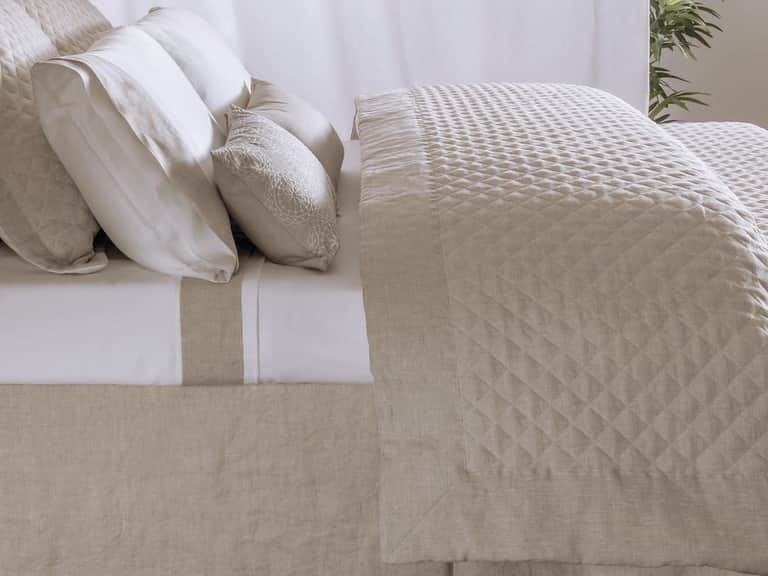
For example, the Bovi Hudson Linen Bed Skirt is described as 100% European linen, fully lined, and tailored with an 18-inch drop. Those details illustrate how lining and precise shaping can create a composed finish around a bed. Because it is a distinct decorative layer rather than a sheet or duvet cover, its care should be considered separately from the routine used for frequently washed sleep linens. Always follow the product’s own care guidance rather than assuming that every linen item can be treated alike.
Care routines that protect construction
Frequent laundering does not have to mean aggressive laundering. Start by reading the care label on each item, since linen, cotton, silk, blends, and trims may require different treatment. Sort by color and fabric weight, and avoid mixing delicate textiles with items that have zippers, hooks, or rough surfaces. Shake bedding out before placing it in the machine so it is less likely to twist into a tight bundle.
- Use the recommended cycle and temperature. A gentle cycle may reduce unnecessary agitation, but the label should guide the choice.
- Give items room to move. Overfilling the drum can lead to uneven washing and add friction to seams and hems.
- Choose detergent thoughtfully. Use a suitable amount and avoid chlorine bleach unless the care instructions specifically permit it.
- Dry with care. Follow the label, remove items promptly, and avoid excessive heat or overdrying where it is not recommended.
- Store only when fully dry. Make sure bedding is clean and dry before folding it away to help keep it fresh between visits.
Prompt attention to stains can prevent the need for harsh treatment later. Blot rather than rub, and test any stain-removal method in an inconspicuous area first. Avoid applying an unfamiliar product to a finished or dyed fabric without checking the care instructions. If a stain is persistent or the textile is delicate, professional cleaning may be the safer choice.
Wrinkles are not always a flaw. Linen’s natural texture can be part of its appeal, and a relaxed finish may suit a guest room better than a perfectly pressed surface. If you prefer a smoother look, consult the label and iron at the recommended setting, using steam if appropriate. Pressing while fabric is slightly damp can be helpful for some linens, but instructions vary by product; the care label remains the authority.
Build a guest-ready rotation
One set can serve a guest room, but a small rotation makes frequent changeovers easier. Keep an extra set of sheets and pillowcases in a clean, dry place so the bed can be remade while the used linens are being washed. Labeling storage by bed size or room can prevent a rushed search for the right fitted sheet. If pieces are sold separately, record fiber content, dimensions, and care instructions to simplify future replacements.
Rotate sets rather than repeatedly laundering the same one whenever possible. This gives fibers time between uses and reduces wear concentrated on a single set. Inspect seams, hems, elastic, and closures as you fold laundry. A loose thread can be secured; a missing button can be replaced; an elastic edge that no longer grips can be addressed before it becomes a problem for the next guest.
Finally, think of presentation as a sequence of practical choices. A fitted sheet that stays in place, pillowcases with tidy closures, and a duvet cover that can be removed without difficulty make the bed easier to care for and more pleasant to use. Add a blanket or coverlet suited to the room’s temperature, but keep the bedding stack manageable enough to wash and store sensibly.
The final check before guests arrive
Before making up the bed, confirm that each piece is clean, dry, and in good repair. Check that the fitted sheet matches the mattress depth, the duvet insert is secured as intended, and the pillowcases fit their inserts without straining the seams. Smooth the surface, arrange any decorative layers, and leave clear care instructions for anyone helping with laundry.
The most successful guest bedding does not demand attention. Its seams are secure, its closures are practical, its fit is dependable, and its care routine is clear. These construction details may be quieter than a beautiful color or an elegant hem, but they are what let the room remain welcoming through one visit after another. Thoughtful choices at the outset make hospitality feel effortless later—and allow the bedding to be lived with, washed, and enjoyed rather than merely admired.